Posts

Showing posts with the label Hematologist

Bone marrow Biopsy

Image
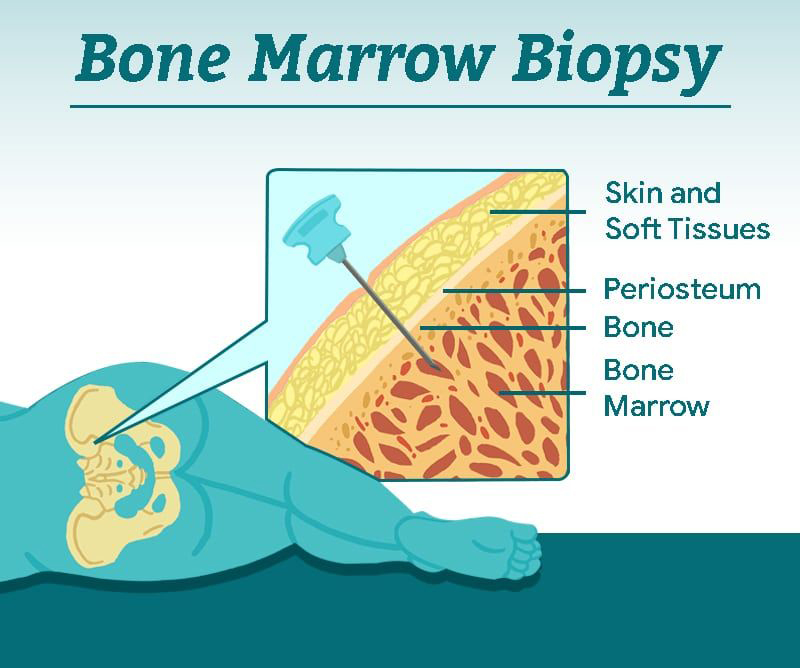
  Bone marrow biopsy (BMB) FAQs! Ever wondered what it's all about? Keep reading... đź‘€ What makes up a BMB? Usually it includes 2 samples - the aspirate (liquid marrow 🩸) and the trephine (bone core 🦴) Why do we need 2 samples? The aspirate allows us to individually look at each BM cell under the microscope 🔬 (e.g. WBCs, RBCs) and classify them via flow cytometry (a method of identifying and measuring pathological cells using their surface markers e.g. CD19 for B-cells) The trephine lets us look at the way the BM is organised and assess for things like fibrosis and infiltration. We can also apply stains đź–Ś (immunohistochemistry) to detect specific cells on the trephine How is it done? It is a quick (20-30 min) awake procedure using local anaesthetic. It does not require a theatre and is often done at the patient bedside. It is done aseptically using 2 separate needles đź’‰ (aspirate and trephine). Where do you take the samples from? Most times we manage to get samples from the pos...

BLOOD CANCER – TYPES AND TREATMENT

Image
Blood Cancer – Types and Treatment Blood accounts for about 8% of our total body weight and plays a vital role in bodily functions; circulating throughout body supplying nutrients, oxygen, antibodies to each and every cell.  Blood cancer occurs due to abnormal multiplying of leukocytes (WBCs). Cancer causes an imbalance in the body due to increase in cell division, leading to excessive production of WBCs. There are three main types of blood cancers: 1. Leukemia: Cancer affecting WBCs or precursor of white blood      cells, increasing their production that can’t fight infections. This      cancer generally originates in the bone marrow rendering its      ability of red blood cells and platelets production. It is further      categorized in four types: • Acute Lymphocytic Leukemia (ALL): As the name suggests, it     affects lymphocytes in the bone marrow. Production of too many     lymphocytes r...

MICROCYTIC AND HYPOCHROMIC ANEMIA IS ONE OF THE COMMON SCENARIO WE ENCOUNTER IN CLINICS

Image
  Clinical Pearls  #DrRajeshBollam  #Hematologist  Microcytic and Hypochromic anemia is one of the common scenario we encounter in Clinics  When we order iron studies  The following are possibilities and Probable diagnosis  *microcytic anaemia with low s.ferritin& high TIBC=iron defeciency anaemia *microcytic anaemia with high s.ferritin&low TIBC=anaemia of chronic diseases *microcytic anaemia with high s.iron= sidroblastic anaemia *microcytic anaemia with NORMAL iron studies=thalassemia  #Hematologist #Hyderabad #Telangana #DrRajeshBollam #anemia BOOK APPOINTMENT

UPDATED RECOMMENDATIONS FOR BREAST CANCER SURVEILLANCE IN YOUNG FEMALE CANCER SURVIVORS

Image
  Updated Recommendations for Breast Cancer Surveillance in Young Female Cancer Survivors William J. Gradishar, MD reviewing Mulder RL et al. J Clin Oncol 2020 Dec 10 Surveillance is now strongly recommended for survivors treated with ≥10 Gy chest radiation — a change from ≥20 Gy. In 2013 the International Late Effects of Childhood Cancer Guideline Harmonization Group (IGHG) published evidence-based recommendations for surveillance of female survivors of childhood, adolescent, and young adult (CAYA) cancer who were treated with radiation to fields that potentially involved breast tissue on the chest wall. Based on new evidence, IGHG has updated its breast cancer surveillance recommendations. BOOK APPOINTMENT Modified recommendations include the following: Mammography and breast MRI should be performed at least annually up to age 60 for survivors treated with ≥10 Gy chest radiation (strong recommendation) and for those treated with upper abdominal radiation that exposed breast tiss...

Stages of LUNG CANCER

Image
  Stages The staging of cancer describes how far it has spread through the body and how severe it is. Staging helps healthcare professionals and individuals decide on a suitable course of treatment. The most basic form of staging is as follows: localized, wherein the cancer is within a limited area regional, wherein the cancer has spread to nearby tissues or lymph nodes distant, wherein the cancer has spread to other parts of the body Similar to this is the TNM staging system. Healthcare professionals assess the tumor for size and spread, whether or not it affects the lymph nodes, and whether or not it has spread elsewhere. There are also specific ways of staging non-small cell and small cell lung cancer. Learn more about the stages of lung cancer here. Stages of non-small cell lung cancer Healthcare professionals typically use tumor size and spread to describe the stages of non-small cell lung cancer, as follows: O...

Lung Cancer and Lung Cancer Screening

Image
Screening Undergoing regular screening may be a good idea for people with a high risk of developing lung cancer. Screening is with a low-dose CT scan. The American Lung Association recommend screening if a person meets all the following criteria: is aged 55–80 years has a history of heavy smoking (30 pack years, which is one pack per day for 30 years or two packs per day for 15 years) currently smokes or has quit smoking within the past 15 years Insurance will often cover this screening if a person is aged 55–80 years and has private health insurance or is aged 55–77 years, has Medicare, and meets all the other criteria. However, people should check with their insurance company before signing up for lung cancer screening. BOOK APPOINTMENT Diagnosis If a person has any symptoms that could indicate lung cancer or if screening shows something unusual, a healthcare professional will likely recommend some diagnostic tests. Imaging tes...

What are the symptoms of lung cancer?

Image
Symptoms of non-small cell lung cancer and small cell lung cancer are basically the same. Early symptoms may include: lingering or worsening cough coughing up phlegm or blood chest pain that worsens when you breathe deeply, laugh, or cough hoarseness shortness of breath wheezing weakness and fatigue loss of appetite and weight loss You might also have recurrent respiratory infections such as pneumonia or bronchitis. As cancer spreads, additional symptoms depend on where new tumors form. For example, if in the: lymph nodes: lumps, particularly in the neck or collarbone bones: bone pain, particularly in the back, ribs, or hips brain or spine: headache, dizziness, balance issues, or numbness in arms or legs liver: yellowing of skin and eyes (jaundice) Tumors at the top of the lungs can affect facial nerves, leading to drooping of one eyelid, small pupil, or lack of perspiration on one sid...

Lung cancer occurs when cells divide in the lungs uncontrollably. This causes tumors to grow. These can reduce a person’s ability to breathe and spread to other parts of the body.

Image
  Lung cancer  is the  third most common Trusted Source  cancer and the  main cause  of cancer-related death in the United States. It is most common in males, and in the U.S., Black males are around 15% more likely to develop it than white males. Smoking is a major risk factor, though not everyone who develops lung cancer has a history of smoking. Lung cancer can be fatal, but effective diagnoses and treatments are improving the outlook. This article will explain what lung cancer is, how to recognize the symptoms, and the treatment options available. What is lung cancer? Cancer  causes changes in cells that are otherwise healthy. The cells  grow too quickly , without dying off. Normal cells in the body usually die at a certain stage in their life cycle, thereby preventing a buildup of too many cells. In cancer, however, the cells continue to grow and multiply. As a result, tumors develop. The two main types of lung cancer are ...